
What 114 Accepted Offers Tell Us About the Twin Cities Housing Market Right Now
If you're trying to figure out what's happening in the Twin Cities housing market, there's always a challenge with the numbers: most of the statistics we see are looking backward.
Closed sales happening today may have been negotiated four to six weeks ago. By the time those transactions make their way into a monthly housing report, the market may already feel different.
That's why I found some recent accepted-offer data particularly interesting.
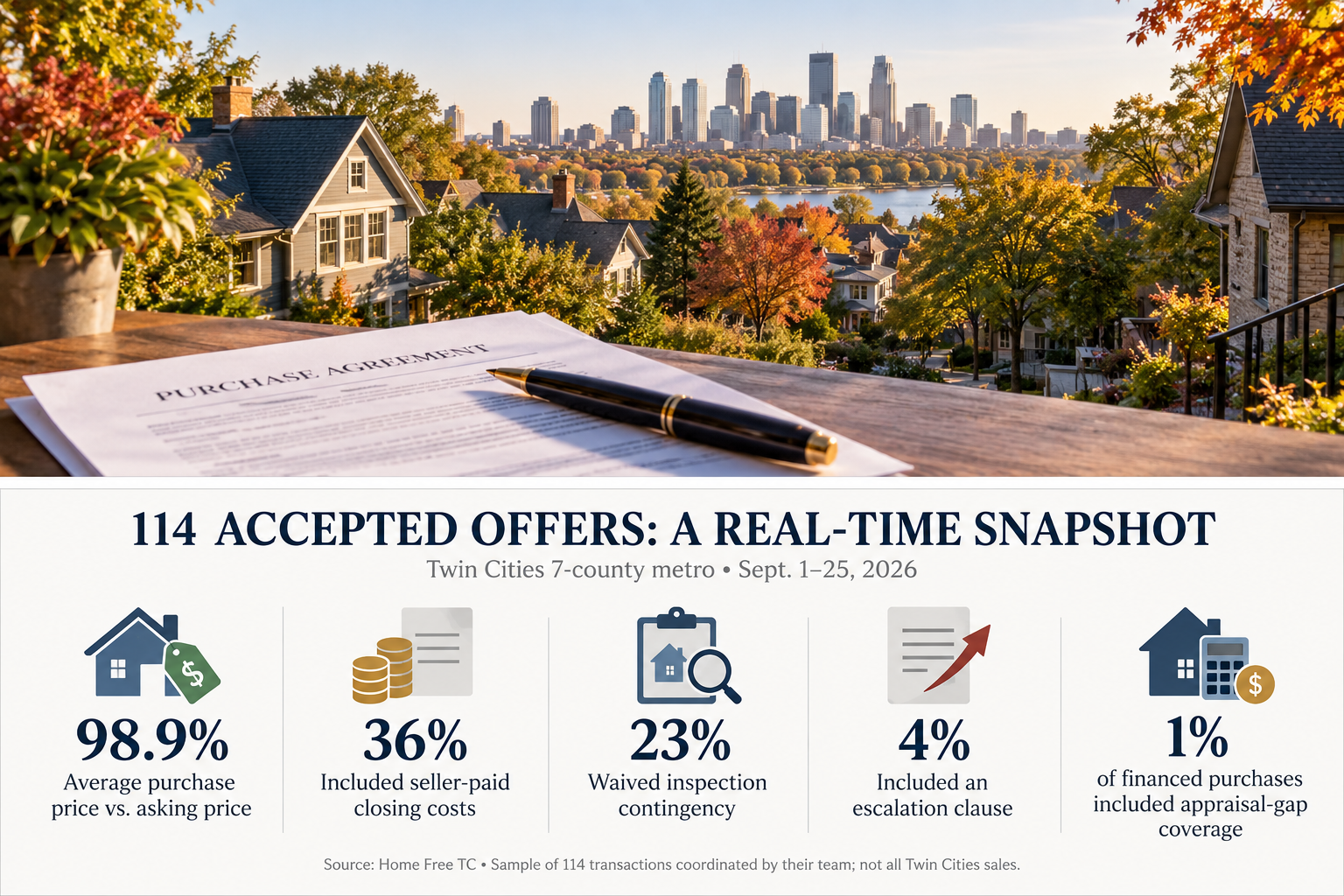
Home Free TC, a Twin Cities transaction coordination company, recently shared data from 114 accepted offers their team coordinated across the seven-county metro between September 1 and September 25, 2026.
It's important to point out that this is a sample of transactions their team coordinated—not every home sale in the Twin Cities. But because these are newly accepted offers rather than closed sales, I think they provide an interesting near-real-time snapshot of what buyers and sellers are actually agreeing to right now.
And the numbers tell an interesting story.
Five Numbers That Stand Out
- 98.9% — average purchase price compared with asking price
- 36% — included seller-paid closing costs
- 23% — waived the inspection contingency
- 4% — included an escalation clause
- 1% — of financed purchases included appraisal-gap coverage
Those numbers shouldn't be interpreted as comprehensive Twin Cities market statistics. They represent one company's sample of accepted offers. But taken together—and compared with what I'm seeing in individual transactions—they provide another useful window into how negotiations are changing.
Buyers Have More Room to Negotiate
The average purchase price among these 114 accepted offers was 98.9% of the asking price.
That doesn't suggest buyers are suddenly getting enormous discounts. Homes that are priced correctly and show well are still selling.
But it does show some variation in where transactions are coming together. Buyers appear increasingly willing to negotiate rather than assuming they need to immediately offer full price or above asking.
We're seeing another indication of that in seller concessions.
Thirty-six percent of the accepted offers in this sample included seller-paid closing costs.
That's more than one out of every three transactions.
Seller-paid closing costs can be particularly valuable to buyers because they can reduce the amount of cash needed at closing. From a seller's perspective, contributing toward closing costs can sometimes make more sense than agreeing to a larger reduction in the purchase price.
Either way, seeing concessions in 36% of this sample suggests buyers are increasingly comfortable asking sellers for something when putting a deal together.
Some Hallmarks of an Ultra-Competitive Market Are Becoming Less Common
A few other numbers caught my attention.
Only 4% of these accepted offers included an escalation clause.
And among financed purchases, only 1% included appraisal-gap coverage.
Those are useful indicators because both strategies tend to become more relevant when buyers believe they're competing against other offers.
An escalation clause can allow a buyer's offer to increase when competing bids come in. Appraisal-gap coverage can give a seller additional confidence that a buyer is prepared to bring additional cash to closing if an appraisal comes in below the purchase price.
When those tools appear infrequently in a group of accepted offers, it suggests that widespread competitive pressure isn't what it was during the most aggressive seller's markets.
But Buyers Will Still Compete for the Right House
Here's the number that keeps this from being a simple "buyers have all the leverage now" story:
Twenty-three percent of these accepted offers waived the inspection contingency.
Nearly one-quarter is still a meaningful number.
It tells me that while buyers may generally have more choices and negotiating room, some are still willing to write very strong offers when they find a property they really want.
That's consistent with what I'm seeing firsthand.
One of my listings in Northeast Minneapolis had been on the market for a while and eventually went a couple of weeks without a single showing.
We made a $15,000 price adjustment, refreshed the presentation and added some staging.
The next buyer through the door loved the house and wrote an offer. We ultimately negotiated the transaction to within roughly 1.5% of the new asking price.
Nothing happened for weeks—and then suddenly we had the right buyer.
That's a pretty good illustration of the market we're in.
Today's Twin Cities Market Can Be a Hurry-Up-and-Wait Game
I'm also hearing from agents across the Twin Cities that activity has become more uneven. Home Free TC has indicated that they're seeing some slowing in the flow of new transactions as well.
I pay attention to observations like that because transaction coordinators see purchase agreements as they're being written. That's considerably earlier in the process than when those same transactions eventually appear as closed sales in market statistics.
None of this means buyers have disappeared.
It means they appear to be becoming more selective.
A house can sit quietly for a couple of weeks and then suddenly attract the buyer who has been waiting for exactly that property.
That's why I think sellers need to be careful about drawing conclusions from any single weekend—or even a short stretch without showings.
At the same time, sellers can't simply ignore what the market is telling them.
The Broader Twin Cities Data Points in a Similar Direction
The accepted-offer sample isn't the only indication that conditions have become more balanced.
According to Minnesota REALTORS' August 2026 housing report, Twin Cities new listings increased 8.2% from a year earlier, while metro sellers received an average of 98.2% of their asking price. Inventory levels were also at their highest level in several years.
That doesn't make every neighborhood or price range a buyer's market. Real estate conditions can vary considerably by location, property type, condition and price point.
But greater inventory gives buyers more properties to compare—and that can change the dynamics of individual negotiations.
What This Means for Twin Cities Home Sellers
In a market like this, three things become increasingly important: price, presentation and patience.
Price
Pricing correctly doesn't necessarily mean being the least expensive property in the neighborhood. It means making sure buyers can understand the value when they compare your home with everything else available to them.
Presentation
Presentation matters because buyers have choices. Staging, photography, condition and the overall experience of walking through a home can make the difference between a buyer continuing their search and deciding they've found the one.
Patience
Sometimes you can do everything correctly and still need to wait for the right buyer to come through the door.
The challenge is knowing the difference between a property that simply needs more exposure and one where the market is signaling that something needs to change.
What This Means for Twin Cities Home Buyers
For buyers, this market may offer opportunities that weren't as readily available during the most competitive periods of the last several years.
That doesn't necessarily mean making an aggressive low offer on every property.
It means understanding where you actually have leverage.
Depending on the property, that could mean negotiating on price, asking for closing-cost assistance, retaining an inspection contingency or simply having enough time to evaluate a home without immediately worrying that several other offers are coming in behind you.
But the 23% inspection-waiver figure is also a reminder that desirable properties can still create competition.
The strategy should depend on the house—not simply on a headline about whether we're in a "buyer's market" or a "seller's market."
So, Is the Twin Cities Housing Market Shifting?
I think the better way to describe it is that the market is becoming more selective and more negotiable.
Buyers are still buying.
Sellers are still getting deals done.
But the terms in this accepted-offer sample suggest buyers aren't feeling the same level of urgency across the board. They're negotiating more, asking for concessions and rarely using some of the aggressive offer strategies associated with highly competitive markets.
For sellers, that puts more emphasis on getting the combination of pricing and presentation right.
For buyers, it means there may be opportunities to negotiate—but the best properties can still command strong offers.
And for both sides, it's another reminder that real estate is extraordinarily local. What's happening with a particular home, neighborhood and price point can matter much more than a metro-wide headline.
Twin Cities Housing Market FAQ
Are Twin Cities homes selling below asking price?
In the Home Free TC sample of 114 accepted offers from September 1–25, 2026, the average purchase price was 98.9% of asking price. That doesn't mean every property sold below asking, and the sample doesn't represent every Twin Cities transaction. Individual results vary considerably by property, location, price and competition.
Are Twin Cities sellers paying buyer closing costs?
Seller-paid closing costs appeared in 36% of the 114 accepted offers in this sample. Whether a seller is willing to contribute depends on the individual property, offer and competitive situation.
Are buyers still waiving home inspections?
Yes. In this particular sample, 23% of accepted offers waived the inspection contingency. That suggests some buyers are still willing to strengthen their terms when they believe a property warrants it, even though other indicators point toward greater negotiating flexibility.
Are escalation clauses still common in the Twin Cities?
They were uncommon in this sample. Only 4% of the 114 accepted offers included an escalation clause. Escalation strategies can still appear when multiple buyers compete for the same property, but they don't appear to be necessary across the market as broadly as they were during more competitive periods.
Is the Twin Cities currently a buyer's market or a seller's market?
It's difficult to accurately describe the entire Twin Cities with a single label. Conditions vary by neighborhood, property type, price range and condition. Recent data suggests buyers have more choices and negotiating opportunities overall, while well-positioned properties can still generate strong competition.
Explore Minneapolis & Twin Cities Real Estate
If you're considering buying or selling, you can explore current homes and neighborhood information throughout Southwest Minneapolis, South Minneapolis, Northeast Minneapolis, Edina and the western suburbs of Minneapolis.
For downtown buyers, you can also explore my Minneapolis Condo Guide.
Thinking About Buying or Selling?
The metro-wide numbers are useful, but the more important question is what the market looks like for the specific home, neighborhood and price range you're considering.
If you're thinking about buying or selling in Minneapolis or the surrounding Twin Cities suburbs, I can help you look at the current competition, recent sales and negotiating environment for your specific situation.
Contact me to talk about your Twin Cities real estate plans.
Source note: Accepted-offer statistics referenced above were shared by Home Free TC and reflect 114 transactions coordinated by their team across the seven-county Twin Cities metro from September 1–25, 2026. This sample should not be interpreted as representing every Twin Cities residential transaction during that period. Broader market context is also informed by Minnesota REALTORS' August 2026 housing market report.
Enjoy this blog post? Click here to subscribe for updates
Leave A Comment