
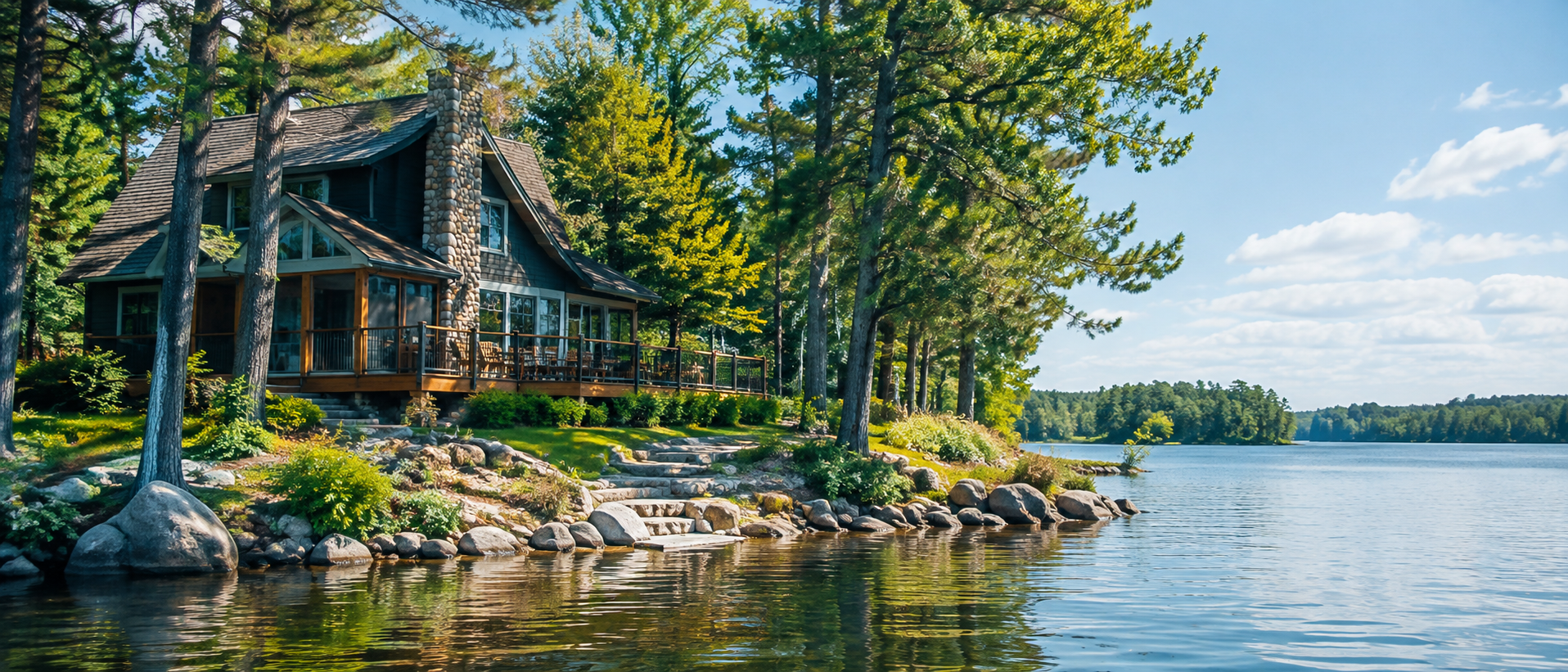
Should I Buy a Vacation Home? Second Homes, Cabins, Airbnb, VRBO and 1031 Exchanges
Owning a second property is one of those real estate decisions that can be equal parts financial and personal.
For some Minnesotans, the goal is a cabin within a few hours of the Twin Cities — a place to spend weekends, get out of the city, be near the water, ski, fish, hike, or simply have a place that feels completely different from home.
For others, the second property is farther away: Scottsdale, Florida, Palm Springs, or another warm-weather destination that becomes part of a winter routine.
And increasingly, I talk with people who want a property to do more than one thing. They want to use it themselves part of the year but also rent it through Airbnb or VRBO when they are not there. Others are selling investment real estate and considering whether a 1031 exchange could eventually become part of a longer-term vacation-home strategy.
After more than 20 years working in real estate, I have seen second properties play very different roles in people's lives. The important first step is figuring out what you actually want the property to be.
Why Do People Buy Vacation Homes?
The reasons are usually more personal than financial.
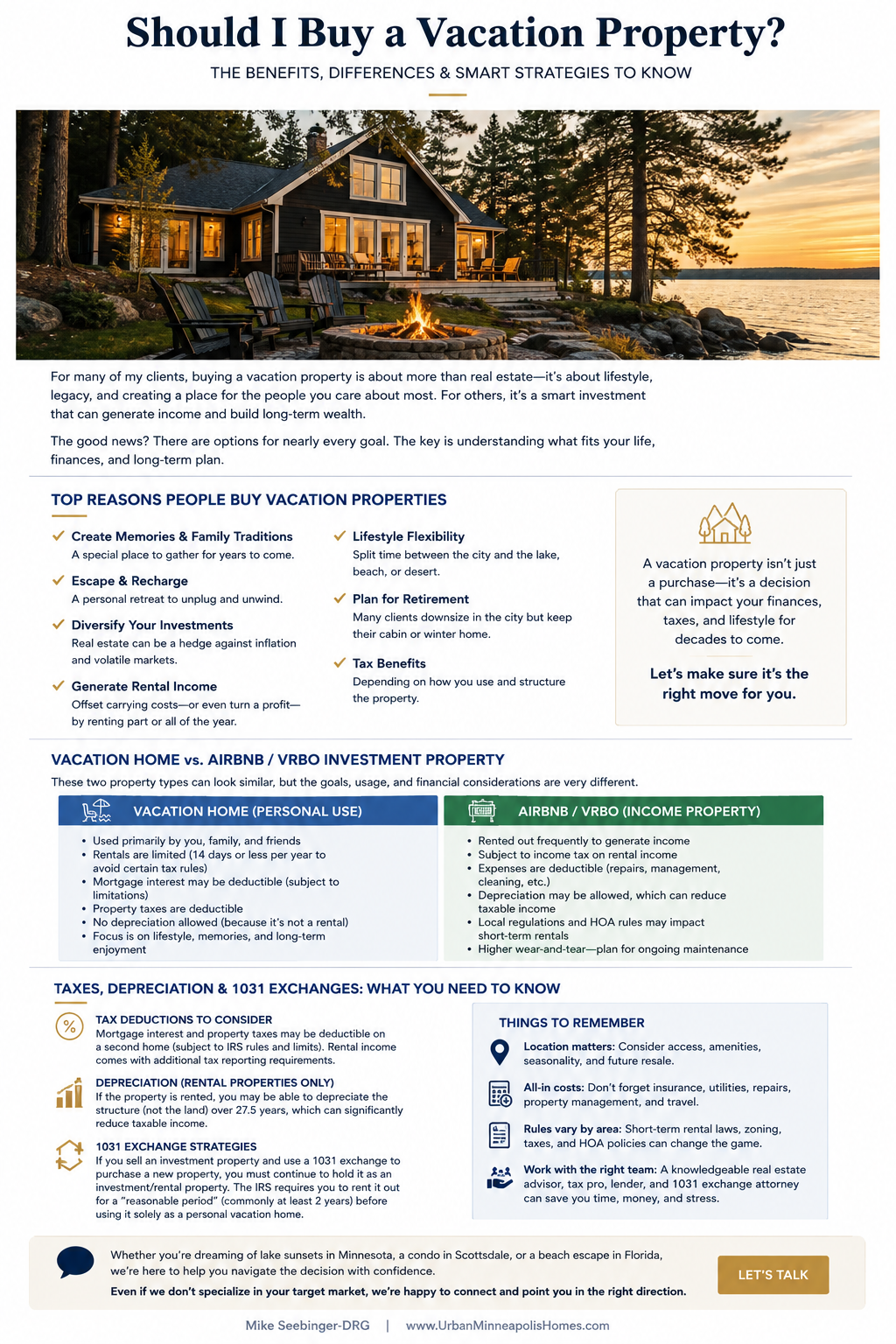
Common motivations include:
- Having a reliable place to get away without planning a trip every time
- Spending more time near lakes, woods, trails, golf, skiing, or other recreational activities
- Creating a place that can be shared with children, grandchildren, friends, or extended family
- Spending part of the winter in a warmer climate
- Owning property in a destination they already visit regularly
- Creating a future retirement or part-time residence
- Building another real estate asset over time
- Generating rental income when the property is not being used personally
There is nothing wrong with buying a vacation property primarily because you want one.
Real estate does not always need to be reduced to a spreadsheet. If you can comfortably afford the property and expect to use it regularly, the value can come from both ownership and experience.
Vacation Home vs. Investment Property: They Are Not the Same Thing
Before buying, it helps to distinguish between three basic strategies.
1. A Personal Vacation Home
This is primarily for your own use.
Maybe it is a lake cabin in Minnesota or Wisconsin, a place near the North Shore, a ski property, or a winter condo in Arizona or Florida.
You may occasionally let friends or relatives use it, but producing rental income is not the primary objective.
2. A Vacation Home That You Also Rent
This is the hybrid model.
You might use the property for several weeks or months each year and rent it through Airbnb, VRBO, or another short-term rental platform during periods when you are not there.
This can offset some of the ownership costs, but it also introduces tax rules, local rental regulations, cleaning, management, insurance, furnishing, guest turnover, and additional wear on the property.
3. A Rental or Investment Property
This property is being held primarily to produce income or for investment purposes.
You may still have a longer-term goal of someday using it personally, but while it is an investment property, the tax and ownership strategy can be very different from a purely personal second home.
What Should I Consider Before Buying a Cabin?
For many Twin Cities homeowners, the classic second-property conversation is still the cabin.
The geography can vary enormously. Some people want to be within 90 minutes of Minneapolis. Others are comfortable driving three or four hours if it gets them the lake, acreage, privacy, or recreational access they want.
Before buying, I would think about:
- Realistically how often you will use it
- Drive time from your primary residence
- Lake access or waterfront quality
- Well and septic systems
- Road access and winter maintenance
- Dock and shoreline responsibilities
- Insurance
- Property taxes
- Maintenance when you are not there
- Whether the property can legally be rented short term
- Internet and cellular service if you expect to work remotely
- Storage for boats, snowmobiles, bikes, or other recreational equipment
A cabin that is easy to use often gets used more.
A spectacular property that requires a five-hour drive, constant maintenance, and complicated seasonal systems may be less enjoyable than a somewhat simpler property that you can reach on a Friday afternoon.
Should I Airbnb or VRBO My Vacation Home?
This is one of the most common questions I hear.
Renting the property while you are not using it can help offset mortgage payments, taxes, insurance, utilities, and maintenance. In some cases, the rental component is what makes the purchase financially comfortable.
But I would never assume a property can be used as a short-term rental simply because similar homes nearby appear on Airbnb or VRBO.
Before buying, verify:
- City or township short-term rental rules
- County licensing requirements
- HOA or condominium restrictions
- Minimum rental periods
- Occupancy limits
- Parking requirements
- Local lodging or sales taxes
- Insurance requirements
- Septic limitations where applicable
Short-term rental rules are very location-specific and can change, so this should be part of your due diligence before writing an offer.
Do I Pay Taxes on Airbnb or VRBO Income?
Generally, rental income must be reported for federal income-tax purposes.
The tax treatment becomes more complicated when a property is used both personally and as a rental because expenses may need to be divided between rental use and personal use.
Under current IRS rules, a vacation property is generally considered used as a home if your personal use exceeds the greater of 14 days or 10% of the days it is rented to others at a fair rental price.
That distinction can affect how rental expenses and losses are treated.
There is also a special rule for very limited rental use. If a dwelling is used as a home and rented for fewer than 15 days during the year, the federal tax treatment is different from a traditional rental property.
This is one of those areas where I strongly recommend talking with a CPA rather than trying to design your ownership strategy around a simplified internet explanation.
Can I Depreciate a Vacation Rental?
Rental real estate may be eligible for depreciation on the portion of the property used for rental purposes.
Depreciation is essentially a tax deduction recognizing the useful life of the rental property. It can reduce taxable rental income, but it also affects the property's adjusted tax basis and can have consequences when the property is eventually sold.
If you are mixing significant personal and rental use, the calculations become more complicated because expenses and depreciation may need to be allocated between the two uses.
Again, this is an area where a CPA should be part of the team before you make decisions based primarily on potential tax savings.
What Is a 1031 Exchange?
A 1031 exchange can allow an owner of qualifying investment or business real estate to exchange that property for other qualifying investment or business real estate and defer recognition of some or all of the taxable gain.
It is a tax-deferral strategy, not a way to simply make the tax disappear.
The property being sold and the replacement property generally need to be held for business or investment purposes.
A common example might be someone who owns a rental duplex, small apartment property, rental condo, or other investment real estate and wants to sell it and move the equity into a different investment property.
Can I Sell More Than One Property and Buy One Through a 1031 Exchange?
Potentially, yes.
A 1031 strategy can involve selling one or multiple investment properties and acquiring replacement real estate, provided the transactions satisfy the applicable tax rules and timelines.
This can be especially interesting for owners who have accumulated several smaller rental properties and would prefer to consolidate their equity into a different asset.
Because the structure and timing matter, this is something that should be planned with a qualified intermediary, CPA, and/or attorney before selling the existing property.
What Are the 45-Day and 180-Day Rules?
In a typical deferred 1031 exchange, the IRS generally requires the replacement property to be identified within 45 days after transferring the property being sold.
The replacement property generally must then be acquired within 180 days of the original transfer, or by the applicable tax-return deadline if that occurs earlier.
Those deadlines are strict, which is why people considering an exchange should have their qualified intermediary and tax professionals involved before the sale closes.
Can a 1031 Exchange Property Eventually Become My Vacation Home?
This is where the strategy gets particularly interesting.
Potentially, yes — but you cannot simply complete a 1031 exchange into a property and immediately treat it exclusively as your personal vacation home.
The replacement property needs to be held for qualifying investment or business purposes.
The IRS provides a safe harbor for certain vacation properties acquired through a 1031 exchange. Under that safe harbor, the replacement property is owned for at least 24 months after the exchange.
During each of the two 12-month periods following the exchange:
- The property is rented at fair market rent for at least 14 days, and
- Your personal use does not exceed the greater of 14 days or 10% of the number of days it is rented at fair market rent.
After the investment-use period, an owner's use of the property can potentially evolve, but the exact facts and intent matter.
This is an area where I would absolutely involve a tax professional and a 1031 exchange specialist before assuming the property can simply become a personal residence or vacation home on a certain date.
A 1031 Exchange Can Be Part of a Longer-Term Lifestyle Plan
I think this is where some real estate owners miss an interesting opportunity.
Imagine someone who owns several rental properties in Minnesota and has accumulated substantial equity.
Instead of keeping those same properties indefinitely, they may decide to sell one or more of them and use a properly structured 1031 exchange to acquire an investment property in Scottsdale, Florida, Palm Springs, a lake community, or another destination they could eventually see themselves using more personally.
Initially, the replacement property needs to satisfy the investment-use requirements of the exchange.
Over time, however, that property may fit into a larger retirement or lifestyle plan.
That can make a 1031 exchange about more than simply replacing one rental with another. It can potentially become part of a longer-term transition in how someone owns and uses real estate.
The Condo-and-Cabin Combination
Another pattern I see fairly often is almost the reverse of buying a second home for the first time.
Someone has owned a single-family home for many years and has accumulated significant equity. They also already own a cabin or recreational property that they have used for a long time.
As their housing needs change, they may sell the larger house, purchase a condominium, and keep the cabin.
The result can be an appealing combination:
- One-level or lower-maintenance city living
- Less exterior maintenance
- Access to restaurants, entertainment, parks, and other amenities
- A lock-and-leave primary residence
- The ability to continue spending extended time at the cabin
For people who already have an established second property, downsizing the primary residence does not necessarily mean giving up space or lifestyle. It can simply mean dividing life between two very different places.
Our Minneapolis Condo Guide is a good place to start if you are considering replacing a larger single-family home with a downtown or neighborhood condominium.
What About Buying a Winter Home?
Minnesota also has a long tradition of seasonal ownership outside the state.
Arizona, Florida, California, and other warmer destinations continue to attract people who want to spend part of the winter away from Minnesota.
The same questions apply:
- Will this be purely personal use?
- Will you rent it when you are not there?
- Is it part of a 1031 exchange?
- Will it eventually become your primary residence?
- How will you manage the property from Minnesota?
- What are the local HOA and rental restrictions?
- How do taxes and insurance differ in that state?
Even when we are not selling real estate in the destination you are considering, we can still help you think through the strategy and connect you with appropriate local real estate professionals.
Should I Finance a Second Home or Pay Cash?
There is no single right answer.
Some buyers use equity from another property. Others finance the purchase. Some sell investment property through a 1031 exchange. Others purchase with cash and retain liquidity elsewhere.
The important thing is to look beyond the purchase price.
Budget for:
- Mortgage payments if applicable
- Property taxes
- Insurance
- HOA dues
- Utilities
- Maintenance
- Property management
- Furniture
- Travel costs
- Dock, boat, pool, landscaping, or recreational expenses
A second property should improve your life rather than create a financial obligation you resent every month.
Should I Buy a Vacation Property?
I usually come back to three questions.
Will you actually use it?
Can you comfortably afford the full cost of owning it?
Do you understand whether you are buying a personal property, an investment property, or something that will function as both?
If those answers are clear, a second property can become one of the most enjoyable pieces of a real estate portfolio.
It can be a cabin you use for decades, a winter property you eventually retire to, an investment that helps produce income, or a property that gradually transitions from investment use to personal use as your life changes.
Thinking About a Second Home, Cabin or 1031 Exchange?
There are a lot of moving pieces, particularly when rental income, depreciation, multiple properties, or a 1031 exchange become part of the conversation.
We have resources for 1031 exchange professionals, lenders, attorneys, tax professionals, and real estate agents in other markets, and we are always happy to start with a conversation about what you are trying to accomplish.
Even if the property you are considering is outside the Twin Cities or outside Minnesota, Schedule a Consultation. We can talk through your overall real estate strategy, help identify the questions you should be asking, and connect you with the appropriate professionals wherever the property is located.
This article is intended for general real estate information and is not tax, legal, or accounting advice. Tax rules can change and individual circumstances vary. Consult a qualified CPA, attorney, and 1031 exchange professional before making decisions based on tax treatment.
Enjoy this blog post? Click here to subscribe for updates
Leave A Comment