

Seller Credit vs. Price Reduction: Which Saves a Home Buyer More?
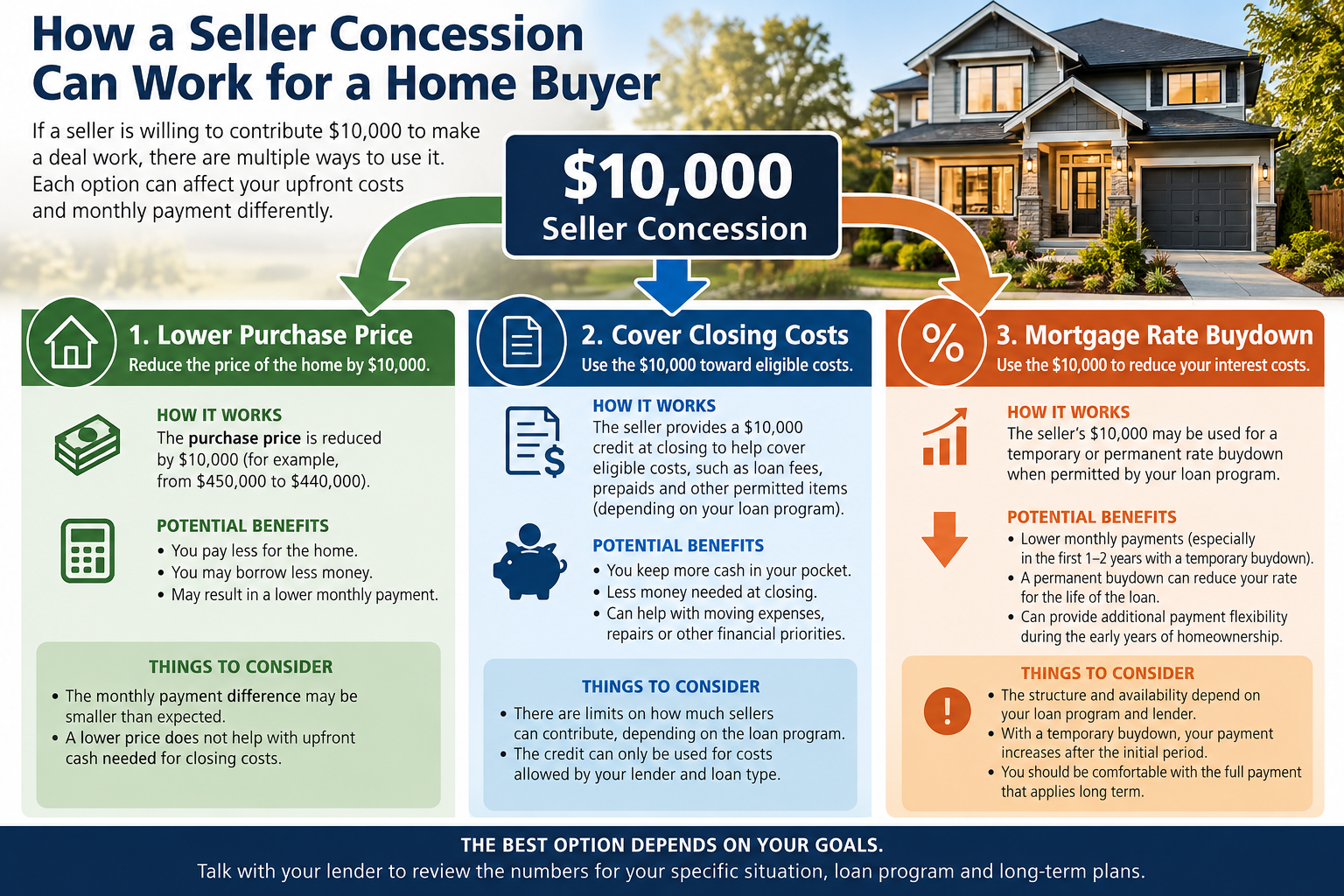
When negotiating the purchase of a home, buyers naturally focus on price. If a seller is willing to give up another $5,000, $10,000 or $15,000 to put a deal together, asking for that amount off the purchase price may seem like the obvious choice.
But it is not always the only option worth considering.
Depending on the buyer's financing and the terms permitted by the loan program, seller dollars may potentially be used toward closing costs or a mortgage rate buydown instead. Those alternatives can affect a buyer's upfront cash requirement or monthly payment very differently than reducing the purchase price.
After more than 20 years helping buyers and sellers negotiate real estate transactions throughout Minneapolis and the Twin Cities, I think the important question is not simply, "How much can we get the seller to come down?"
A better question is:
"If the seller is willing to contribute money to make this transaction work, where does that money provide the most value for this particular buyer?"
Why a $10,000 Price Reduction May Not Lower the Payment as Much as You Think
Imagine you are negotiating on a $450,000 home and the seller is willing to improve the deal by $10,000.
One option would be to reduce the purchase price from $450,000 to $440,000.
That certainly has value. You are paying less for the property and, depending on the financing, borrowing somewhat less money.
But a mortgage spreads that difference over many years. As a result, a $10,000 reduction in purchase price does not normally translate into a $10,000 immediate benefit or an enormous reduction in the monthly payment.
Another possibility may be negotiating a seller credit and, when permitted, using some or all of it toward eligible financing costs such as a mortgage rate buydown.
The same seller dollars can therefore produce very different results depending on how they are structured.
What Is a Seller Credit?
A seller credit, sometimes referred to as a seller concession, is an amount the seller agrees to contribute toward certain buyer costs as part of the transaction.
Depending on the buyer's loan program and lender requirements, eligible seller concessions may potentially be applied toward certain closing costs, prepaid expenses or financing-related costs.
There are limits and rules governing how seller concessions can be used. The amount permitted can depend on the loan program, down payment, occupancy, transaction and other factors.
That is why a buyer should have a lender calculate the actual options rather than assuming a particular credit can be used in a particular way.
What Is a Mortgage Rate Buydown?
A mortgage rate buydown uses funds paid at closing to reduce the cost of the buyer's mortgage payments according to the structure of the particular buydown.
There are different types of buydowns, and they should not all be treated as the same thing.
Temporary Buydowns
A temporary buydown reduces the buyer's payment during the first years of the mortgage without changing the underlying note rate.
One commonly discussed version is a 2-1 buydown.
With a typical 2-1 structure, the buyer's payment during the first year is calculated as though the interest rate were two percentage points below the note rate. During the second year, it is calculated as though the rate were one percentage point below the note rate. Beginning in the third year, the buyer makes the full payment based on the note rate established at closing.
The actual mortgage rate itself has not stepped up each year. Funds set aside for the temporary buydown are used to supplement the reduced payments during the temporary period.
Permanent Rate Buydowns
A permanent rate buydown is different. In that situation, money is generally paid upfront in exchange for a lower mortgage interest rate for the life of the loan, subject to the lender's pricing and program requirements.
Whether paying points for a permanently lower rate makes financial sense depends on the cost of the buydown, the resulting rate reduction and how long the buyer expects to keep that mortgage.
Price Reduction vs. Seller Credit: A Simple Example
Consider a hypothetical $450,000 home.
The seller is willing to make a $10,000 concession to reach an agreement.
The buyer and seller might consider several structures:
- Reduce the purchase price by $10,000.
- Keep the purchase price and negotiate an eligible seller credit toward buyer closing costs.
- Use an eligible seller concession toward a temporary mortgage buydown.
- Use an eligible seller concession toward a permanent rate buydown.
- Use a combination of strategies when permitted by the loan program and transaction.
These options are not financially equivalent.
A price reduction decreases the amount paid for the house. A closing-cost credit may allow the buyer to retain more cash after closing. A temporary buydown may create larger payment relief during the first couple of years. A permanent buydown may reduce payments for a longer period.
Which provides the most value depends on the buyer.
When a Lower Purchase Price May Make More Sense
There are plenty of situations where I would rather negotiate the price.
A lower purchase price may be particularly valuable when the property is simply overpriced relative to comparable sales.
Price can also matter because it establishes the contractual value of the transaction and affects the amount being financed.
If a buyer does not need assistance with closing costs and the financing alternatives do not provide compelling value, negotiating the strongest possible purchase price may be the straightforward choice.
There is also a difference between solving a financing issue and solving a property-value issue. A financing incentive should not be used to ignore the fact that a home may be priced above what the market supports.
When a Seller Credit May Be More Valuable
For some buyers, preserving cash can be more important than obtaining a modest reduction in the monthly payment.
Buying a home involves more than the down payment. Depending on the transaction, buyers may also have closing costs, prepaid taxes and insurance, moving expenses, immediate repairs, furniture or planned improvements.
If permitted by the loan program, using seller dollars toward eligible closing costs can potentially leave the buyer with more cash available after closing.
That can make a seller credit worth evaluating even when the buyer could afford those costs without assistance.
When a Temporary Buydown May Be Worth Considering
A temporary buydown may appeal to a buyer who wants additional payment flexibility during the first couple of years of homeownership.
For example, a buyer may anticipate other near-term expenses associated with moving or improving the property.
But there is an important qualification:
A buyer should be comfortable with the full mortgage payment that eventually applies.
A temporary buydown should not be used to justify purchasing a home that only works financially while the temporary subsidy is in effect.
What If Mortgage Rates Fall Later?
Buyers sometimes look at a temporary buydown and assume they will simply refinance before the reduced-payment period ends.
That is possible, but it should not be the foundation of the purchase decision.
Future mortgage rates are unknown. Refinancing also depends on the homeowner's financial situation, property value, loan balance, lending requirements and the economics of refinancing at that time.
I would evaluate the purchase assuming the existing mortgage remains in place. If refinancing becomes attractive later, that can be evaluated when the opportunity actually exists.
The Seller Side of the Equation
This strategy matters to sellers, too.
Suppose a home has been on the market and buyer feedback repeatedly comes back to affordability. The automatic response may be another price reduction.
Sometimes that is exactly what the property needs.
But before making the decision, I think it is worth asking a lender to run the numbers.
If a seller is considering giving up $10,000 either way, it can be useful to understand how a $10,000 price adjustment compares with an eligible $10,000 financing concession from the perspective of a potential buyer.
The seller can then make a pricing decision with more information rather than assuming every $10,000 concession has the same effect.
Price Still Matters
None of this means sellers should avoid reducing an overpriced home.
If comparable sales, market activity, showing traffic and buyer feedback indicate that the property is priced above the market, a financing incentive does not automatically solve the underlying issue.
There is also a marketing difference between the two strategies. A lower asking price may expose the property to buyers searching below a particular price threshold, while a seller credit does not change the list price.
That is why pricing and financing incentives should be evaluated together rather than treating one as a universal replacement for the other.
Don't Negotiate the Credit Until You Know Whether You Can Use It
This is one of the most important practical points for buyers.
Before structuring an offer around a large seller credit, talk with your lender.
The lender should determine:
- How much seller contribution is permitted for your financing.
- Which costs the credit can legally and practically cover.
- Whether a temporary buydown is available with your loan program.
- What a permanent rate buydown would cost.
- How each option changes your estimated cash to close.
- How each option changes your estimated monthly payment.
- What happens to the payment after a temporary buydown expires.
Once those numbers are available, your real estate agent can incorporate them into the negotiation strategy.
A Better Way to Compare an Offer
If I were helping a buyer evaluate these choices, I would want to see the scenarios next to each other.
For example:
- Scenario A: Lower purchase price.
- Scenario B: Original price with seller-paid closing costs.
- Scenario C: Original price with an eligible temporary rate buydown.
- Scenario D: Original price with an eligible permanent rate buydown.
Then compare the estimated monthly payment, cash required at closing and longer-term financial implications of each.
There is no reason to guess when a lender can calculate the scenarios using the actual property, loan program, down payment and current mortgage pricing.
Seller Credits and Mortgage Buydowns FAQ
Is a seller credit better than a price reduction?
Not automatically. A price reduction lowers the purchase price, while an eligible seller credit may be used toward certain closing or financing costs. The better option depends on the buyer's loan, available cash, mortgage terms and goals.
Does a $10,000 price reduction lower my mortgage payment by $10,000?
No. A price reduction generally reduces the amount being financed, and that savings is spread over the mortgage term. The actual monthly-payment difference depends on the loan amount, down payment, interest rate and mortgage structure.
What is a 2-1 mortgage buydown?
A 2-1 temporary buydown generally provides a payment calculated as though the interest rate were two percentage points lower during the first year and one percentage point lower during the second year. Beginning in year three, the payment is based on the full note rate established at closing, subject to the specific loan and buydown terms.
Does the mortgage interest rate actually change with a 2-1 buydown?
With a typical temporary 2-1 buydown, the underlying note rate does not change. Funds allocated to the buydown supplement the temporarily reduced payments.
Can a seller pay for a mortgage rate buydown?
Seller funds may be used for certain mortgage buydowns when permitted by the buyer's loan program and lender. Contribution limits, eligibility and other requirements vary, so the lender should confirm the structure before it is included in an offer.
What happens after a 2-1 buydown ends?
After the temporary buydown period, the buyer makes the full payment based on the note rate established at closing. Buyers should be financially comfortable with that payment when deciding whether to purchase the home.
What happens if mortgage rates fall after I buy?
A homeowner may be able to evaluate refinancing if rates and their individual circumstances make it worthwhile. Refinancing is not guaranteed, however, so a purchase should make financial sense without depending on a future refinance.
Can I use a seller credit for anything I want?
No. How seller concessions can be used depends on the mortgage program, lender requirements, transaction and the buyer's circumstances. Buyers should have their lender confirm allowable uses and limits.
Run the Numbers Before You Negotiate
Purchase price will always matter, but it is only one part of a real estate negotiation.
If a seller is willing to contribute several thousand dollars to make a transaction work, buyers should understand what those dollars could accomplish before deciding where to put them.
Sometimes the answer will be a lower price. Sometimes it may be help with closing costs. In other circumstances, an eligible temporary or permanent mortgage rate buydown may deserve consideration.
The important part is to compare the actual numbers for the buyer, property and loan rather than assuming one strategy is always better.
If you are buying or selling a home in Minneapolis or the surrounding Twin Cities and want to talk through how price, seller concessions and financing can affect a negotiation, Schedule a Consultation.
Financing examples and concepts discussed here are for general educational purposes only. Mortgage rates, payments, loan eligibility, seller-concession limits, closing costs, taxes, insurance, mortgage insurance and buydown options vary by borrower, property, loan program, lender and market conditions. Buyers should obtain a personalized financing analysis from a licensed mortgage professional.
Enjoy this blog post? Click here to subscribe for updates
Leave A Comment