
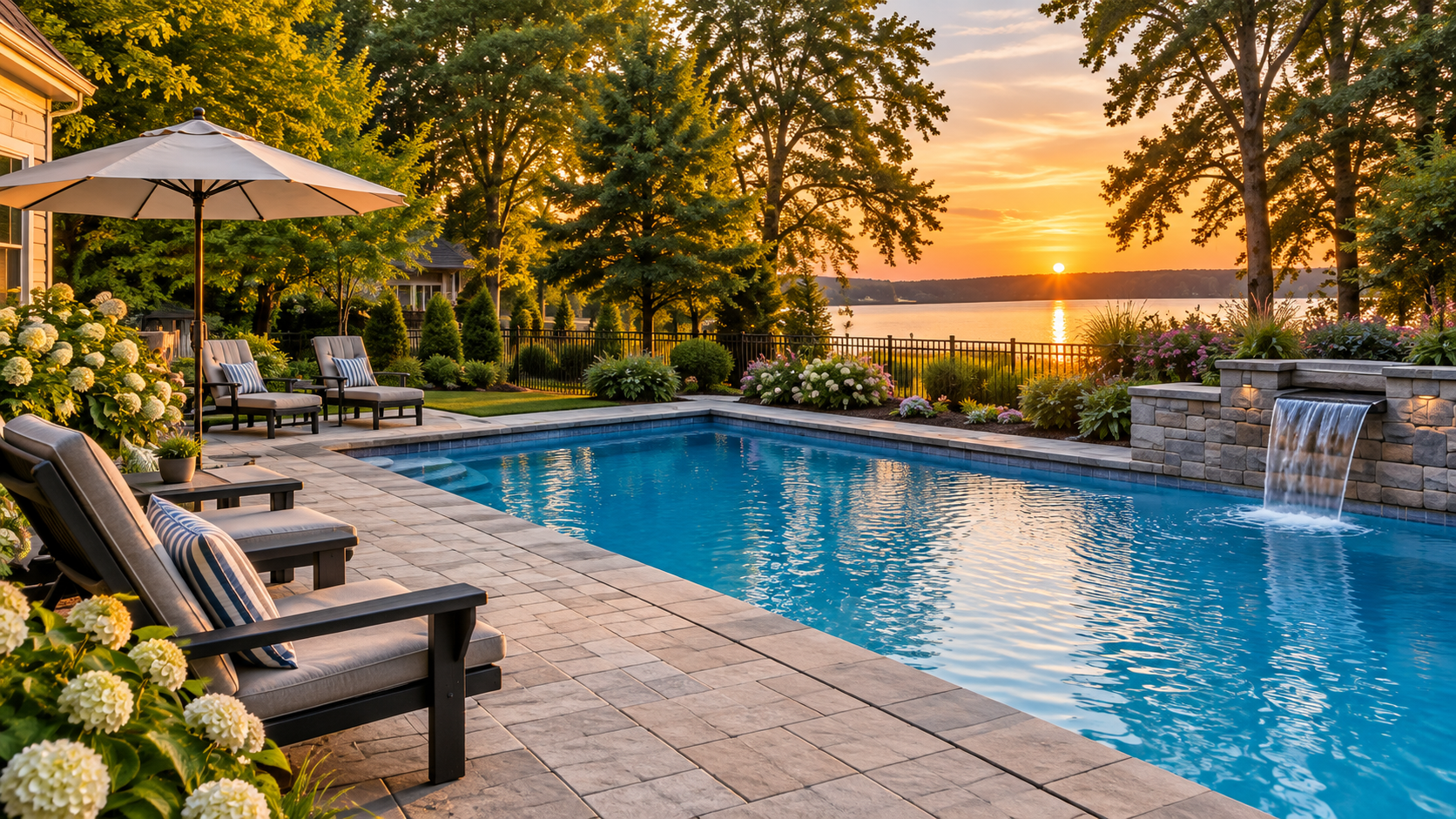
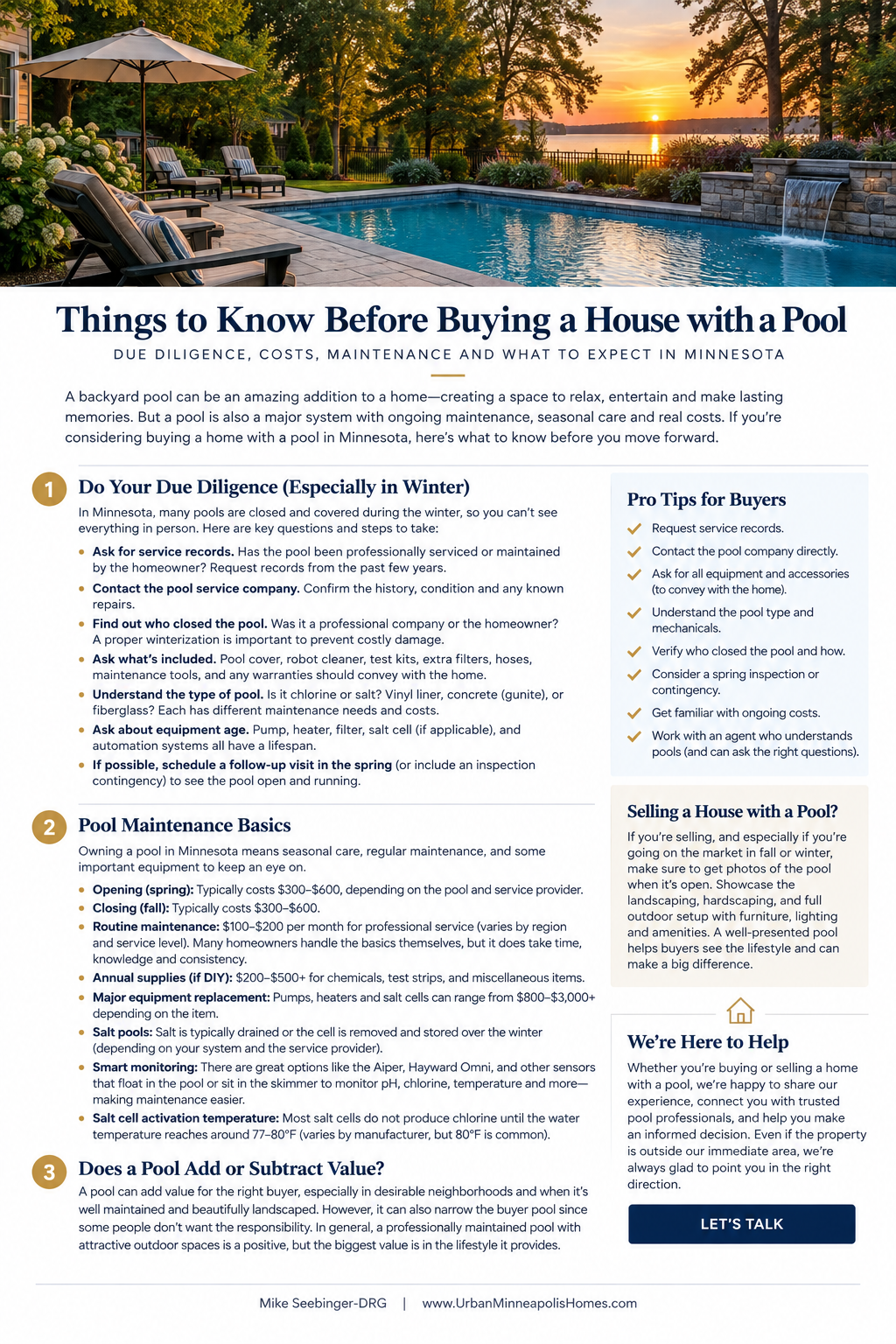
Buying a House With a Pool in Minnesota? What to Know Before You Buy
A swimming pool can be one of the most enjoyable features a home can have — especially during a Minnesota summer.
It can also be one of the more specialized systems on a property.
When I am working with buyers considering a home with a pool, I want them to think about the pool the same way we would think about a roof, furnace, sewer line, or other major component of the property. It should be evaluated carefully, maintained properly, and understood before closing.
This becomes especially important in Minnesota because many homes are bought and sold while the pool is completely shut down for winter.
Buying a Home With a Pool in Winter
Winter is the hardest time to evaluate a Minnesota pool because much of the system may be winterized and buried under snow.
Just as you cannot fully evaluate a roof under a foot of snow, you may not be able to see the pool surface, water condition, liner, plumbing, equipment operation, or landscaping around the pool.
That does not mean you cannot perform meaningful due diligence.
I would ask for as much history and documentation as possible.
Ask Who Has Been Servicing the Pool
One of the first questions I would ask is whether the pool has been professionally maintained or primarily handled by the owner.
If a pool company has been involved, ask for:
- Name and contact information for the pool service company
- Recent service records
- Opening and closing invoices
- Repair history
- Equipment replacement history
- Any recommendations the service company has made
If possible, contact the company that has serviced the pool. A longtime service provider may know much more about the condition of the system than someone seeing it for the first time in January.
Find Out Who Closed the Pool
Proper winterization is especially important in Minnesota.
Freezing water can damage:
- Plumbing lines
- Pumps
- Filters
- Heaters
- Valves
- Salt systems
- Other pool equipment
I want to know whether the pool was closed professionally, when it was closed, and whether the homeowner has documentation.
A properly winterized pool is much more reassuring than simply hearing that someone “shut everything down.”
Ask for Photos of the Pool Open
If you are buying during the winter, ask the seller for summer photos.
Ideally, you want to see:
- The pool filled and operating
- Pool surface or liner
- Decking and hardscape
- Landscaping around the pool
- Pool cover
- Furniture placement
- Fencing and gates
- Equipment area
This helps you understand not just the pool itself, but how the entire backyard functions when everything is open.
What Pool Equipment Should Come With the House?
When buying a house with a pool, I like to make sure everyone understands what equipment is included in the sale.
That may include:
- Pool robot or automatic cleaner
- Winter cover
- Solar cover
- Cover reels
- Vacuum equipment
- Skimmer nets
- Brushes
- Poles
- Test kits
- Replacement filters
- Pool chemicals
- Pool furniture if negotiated
- Safety equipment
Some of those items can cost hundreds or even thousands of dollars to replace, so it is worth clarifying exactly what stays with the property.
What Kind of Pool Is It?
Not all pools are constructed or maintained the same way.
Common residential pool types include:
- Concrete or gunite pools
- Vinyl-liner pools
- Fiberglass pools
Each has different long-term maintenance considerations.
For example, a vinyl liner eventually needs replacement. Concrete pools may eventually require resurfacing. Fiberglass pools have their own maintenance and repair considerations.
The more you understand about the actual pool structure, the easier it is to anticipate future expenses.
Saltwater Pool vs. Traditional Chlorine Pool
A saltwater pool still uses chlorine.
The difference is that a salt chlorine generator converts dissolved salt in the pool water into chlorine.
Some homeowners prefer this because the system can provide a steadier chlorine level and reduce the amount of chlorine that needs to be manually added.
Salt systems still require maintenance, however.
The salt cell eventually wears out and may need replacement, and the cell can accumulate scale and require cleaning.
If the home has a saltwater pool, ask:
- How old is the salt cell?
- Has it been cleaned regularly?
- Has it ever been replaced?
- Where is the cell stored during winter?
- Did the pool company remove it for cleaning or storage?
Depending on the equipment, replacement salt cells can cost several hundred dollars. Minneapolis-area cost guides currently show replacement commonly falling in roughly the $280 to $850 range, although actual costs vary substantially by system and installation.
Where Is the Salt Cell in Winter?
On some Minnesota pools, the salt cell is removed during winterization and stored indoors. In other cases, the pool company may take the cell with them for cleaning or service.
If you are buying the house during the winter, verify where the salt cell actually is.
The same goes for removable filter cartridges and other equipment that may not currently be installed.
You do not want to discover after closing that an expensive component is missing.
One Important Correction About Cold Water and Salt Systems
Salt chlorine generators generally stop producing chlorine in cold water, but the shutoff temperature is much lower than 80 degrees.
The exact threshold depends on the manufacturer and model.
For example, current Pentair IntelliChlor systems begin displaying a low-temperature warning below about 60°F and shut off chlorine generation around 52°F. Hayward AquaRite systems commonly stop generating around 50°F.
So if a Minnesota pool is open during cool spring weather, the water may need to be chlorinated manually until it becomes warm enough for the salt system to operate normally.
Pool Mechanical Systems to Evaluate
A pool has its own collection of mechanical equipment, and buyers should understand the age and condition of each major component.
That may include:
- Pump
- Filter
- Heater
- Salt chlorine generator
- Automation system
- Valves
- Plumbing
- Lights
- Automatic cover system
- Pool cleaner
I would ask when major components were installed or replaced and whether any equipment has required repeated repairs.
How Much Does Pool Maintenance Cost in Minnesota?
Pool ownership costs vary widely depending on pool size, construction type, equipment, landscaping, whether you handle maintenance yourself, and whether you hire a professional.
As a rough Minneapolis-area guide, current service estimates commonly show:
- Seasonal pool opening: roughly $350 to $650
- Seasonal pool closing or winterization: roughly $350 to $650
- Routine service visits: roughly $100 to $190 per visit depending on scope
- DIY chemicals and basic maintenance supplies: often roughly $50 to $100 per month during the season
Another Minneapolis service source currently shows weekly full-service plans around $120 to $250 per month, while some local companies quote weekly visits around $78 per week. The difference usually comes down to what is actually included — chemicals, filter cleaning, vacuuming, equipment checks, and minor repairs can vary considerably between companies.
I would treat all of those numbers as rough budgeting figures and get an actual quote for the specific pool.
What Does Professional Pool Service Usually Include?
A typical professional maintenance visit may include:
- Testing water chemistry
- Adjusting chlorine, pH, and alkalinity
- Skimming debris
- Brushing walls and steps
- Vacuuming
- Emptying skimmer and pump baskets
- Cleaning or checking filters
- Inspecting pumps and heaters
- Checking salt systems
Professional service can also catch equipment problems before they turn into larger repairs.
Can You Maintain the Pool Yourself?
Absolutely.
Pool maintenance is not rocket science, but it does require attention.
I personally manage my own pool under a few different circumstances, and I have learned that the system is manageable once you understand it.
I have also learned that mistakes can get expensive quickly.
Running equipment incorrectly, allowing chemistry to get badly out of balance, failing to winterize properly, or misunderstanding a salt system can damage equipment or pool surfaces.
If you enjoy learning how systems work and do not mind monitoring things regularly, maintaining your own pool can be completely reasonable.
If you would rather not take on that responsibility, hiring a professional is money well spent.
Smart Pool Monitoring Tools
Traditional test strips and liquid test kits still work very well.
There are also smart pool-monitoring devices that can track water conditions and send information to your phone.
Depending on the device, these systems may monitor:
- Water temperature
- pH
- Chlorine-related readings
- Other water-quality measurements
Some devices float in the pool while others sit in or near the skimmer.
They do not completely eliminate the need to understand pool chemistry, but they can make monitoring easier.
Does a Pool Add Value to a Home?
Sometimes.
A pool is not universally positive or negative for resale.
There are buyers who specifically search for homes with pools, and I regularly work with people who will only consider properties that already have one.
There are also buyers who do not want the maintenance or responsibility.
That means a pool may narrow the buyer pool while making the home considerably more appealing to the people who actually want one.
I generally think the most important reason to own a pool is because you will enjoy using it.
If it also adds value when you eventually sell, that is a bonus.
Selling a House With a Pool in Winter
If you think you may sell a Minnesota home with a pool during the winter, take photos while the pool is open.
This is extremely important.
Good summer photography should show:
- Pool filled and clean
- Landscaping
- Decking and hardscape
- Outdoor furniture
- Pool lighting if applicable
- Cabana or outdoor kitchen
- Fencing
- The overall backyard environment
A snow-covered winter yard does not communicate what the backyard actually feels like in July.
Strong summer photos help buyers understand the lifestyle component of the property even when the pool is closed.
Should You Buy a House With a Pool in Minnesota?
If you want a pool, I would not let the maintenance scare you away.
Just go into the purchase understanding what you are buying.
Ask about service history. Understand the equipment. Find out who opened and closed the pool. Review photos if you are buying during the winter. Make sure all of the equipment and accessories are accounted for.
And if the pool is a major part of why you are buying the house, consider having a pool professional involved in your due diligence whenever possible.
Looking at a Minnesota Home With a Pool?
Homes with pools require a slightly different level of due diligence, particularly when the purchase happens during the winter.
If you are considering a home with a pool in Minneapolis or anywhere around the Twin Cities, Schedule a Consultation. We can help you think through the property, ask the right questions, coordinate additional evaluation when appropriate, and understand what pool ownership may look like after closing.
Posted by Mike Seebinger on
Enjoy this blog post? Click here to subscribe for updates
Leave A Comment